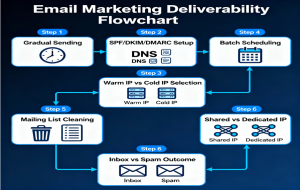
Why IP Choice Really Matters
Mailbox providers like Gmail, Yahoo, and Outlook evaluate your IP reputation to determine where your emails land—Inbox, Promotions, or Spam.
- A strong IP reputation → better inbox placement
- A weak or unestablished reputation → increased spam placement
- Irregular or inconsistent sending → reduced trust from mailbox providers
For marketing senders, choosing an appropriate IP setup based on sending behavior is essential to maintaining healthy deliverability.
Shared IP Overview
A Shared IP is used by multiple senders on the same platform (e.g., SendGrid’s shared pools).
Advantages
- No warm-up required
- Suitable for low-volume or occasional marketing sends
- Cost-effective
- Reputation is partially managed by the email service provider
- Stable performance even when sending patterns vary
Disadvantages
- IP reputation is shared among many senders
- Temporary dips may occur if another sender’s activity impacts the pool
- Less direct control over reputation
Shared IPs provide flexibility for senders whose email activity varies over time.
Dedicated IP Overview
A Dedicated IP is used exclusively for your business.
Advantages
- Full control over your IP reputation
- Ideal for high-volume daily or weekly communications
- Suitable for enterprise, regulated, or brand-controlled messaging environments
Disadvantages
- Requires warm-up
- Not ideal for infrequent or burst-style sending
- Higher cost and greater responsibility
- Requires continuous monitoring of:
- Volume
- Bounce rates
- Spam complaints
- Engagement performance
- Volume
For senders with consistent and predictable volumes, a dedicated IP offers precision and control.
Which Should You Choose?
Best Fit for Shared IP
- Sending fewer than 100,000 emails per year
- Monthly, occasional, or seasonal marketing campaigns
- New or small/medium-sized businesses
- Senders without the capacity to maintain a warm and active dedicated IP
Best Fit for Dedicated IP
- High-volume daily or weekly marketing sends
- Consistent and stable sending patterns
- Organizations that require fully controlled reputation management
- Teams equipped to manage warm-up and deliverability metrics
Sending Pattern Guidance
| Sending Behavior | Recommended IP | Reason |
| Occasional or seasonal campaigns | Shared IP | Low frequency cannot sustain a dedicated IP reputation |
| High daily or weekly volume | Dedicated IP | Supports strong, independent reputation and stable inboxing |
| Irregular or bursty sending | Shared IP | Avoids reputation resets or cold-IP issues |
| Enterprise-level sending | Dedicated IP | Meets compliance and control requirements |
Risks for Occasional Senders Using Dedicated IPs
Senders who use a dedicated IP but send infrequently may experience:
1. Reputation Decline Due to Inactivity
Mailbox providers expect consistent activity. Long gaps create trust issues.
2. Cold IP Problems
After inactivity, the IP may be treated like a “new sender,” increasing spam placement.
3. Volume Spikes Trigger Filters
Large sends following long pauses often look suspicious to mailbox providers.
4. Required Warm-Up
A dedicated IP must be warmed gradually and continuously—not only once.
Maintaining stable sending is essential to keeping a dedicated IP healthy.
Why Shared IPs Work Well for Many Marketing Senders
Shared IP pools offer:
- Ongoing, steady volume
- Mixed sending behaviors that stabilize reputation
- Reduced impact from periods of inactivity
- Infrastructure that is actively managed by the ESP
If issues arise, service providers can isolate problematic senders or rebalance pools to protect overall performance.
If You Use a Dedicated IP: What Happens When Sending Bulk?
Bulk campaigns on a dedicated IP work best when your sending is:
- Consistent (not sporadic)
- Properly warmed
- Engagement-focused
- Clean-list based (no purchased or unverified lists)
If not managed correctly, bulk campaigns may trigger:
- Spam folder placement
- IP blocks
- Rate limiting
- Deliverability drops requiring re-warm-up
Best Practices for All Marketing Senders (Recommended by SendGrid)
1. List Hygiene
- Remove inactive subscribers
- Avoid purchased/third-party lists
- Use double opt-in where possible
2. Authentication
- Set up SPF, DKIM, and DMARC
- Use a dedicated sending domain
3. Engagement-Based Sending
- Start with your most engaged audience
- Expand gradually to less engaged segments
4. Content Quality
- Avoid spammy wording
- Personalize messaging
- Use a visible unsubscribe link
5. Consistent Sending
- Prevent extended periods of silence
- Maintain steady engagement
- Warm up before seasonal or large sends
6. Monitor Reputation
Use:
- Google Postmaster Tools
- Spamhaus
- Twilio SendGrid analytics
7. Dedicated IP Warm-Up
If using a dedicated IP:
- Start with your top 20–30% engaged users
- Increase volume gradually over 2–3 weeks
Conclusion
Both Shared and Dedicated IPs are effective—the right option depends entirely on your sending pattern and marketing volume.
Choosing an IP configuration aligned with your consistency, volume, and reputation goals will significantly enhance deliverability, inbox placement, and overall campaign performance.